
What Fayette Deed Records Show
A deed is a recorded instrument that transfers an interest in land. In Fayette County, deed records sit alongside correction deeds, condominium documents, land contracts, easements, releases, wills, and court orders. The instrument type matters more than the name match. A person listed in the index did not always buy or sell the parcel.
| Deed Type | What It Does | Common Use |
|---|---|---|
| Deed | Records a transfer of a real-property interest | Sale or other conveyance |
| Deed of correction | Corrects a stated error in an earlier deed | Name, description, or reference correction |
| Condo deed | Transfers a condominium unit interest | Unit-specific ownership |
| Affidavit of descent | Places inheritance facts in the land record | Estate-related title trail |
| Commissioner's deed | Records a court-directed conveyance | Judicial sale or partition |
Fayette County publishes an unusually detailed instrument list. Deed, condo deed, correction deed, agreement to deed, land contract, master deed, easement, mortgage, release, judgment lien, plat, will, and order categories all appear there. Read the image and its related references first. Only then decide what legal effect a row actually had.
Fayette Grantor-Grantee Search Modes
Party searches in the Fayette Deeds land-record index come in three modes. One name can run across both roles. A single name can be pinned to a specified role. Or a known grantor and grantee can be paired with common instruments. The specified-party choice cleanly separates transfers out from transfers in. Company names belong in the last-name/company field.
| Field | Use | Format Note |
|---|---|---|
| Party name | Find a grantor, grantee, or either role | Last/company, first, middle initial |
| Street | Find an address-related instrument | Use number and name conservatively |
| Subdivision, lot, block | Narrow by recorded description | Copy terms from a deed or plat |
| Instrument, book, page | Open an exact record | Preserve suffixes |
| Date and consideration | Reduce a broad result set | Dates use MM/DD/YYYY |
Any individual search stops at 1,000 results. Narrow a common name with dates, deed type, street, subdivision, or both parties instead of treating the first page as complete. The broader Fayette County property search covers address and parcel matching in more depth, and the live Clerk index displays these controls with its verification status.
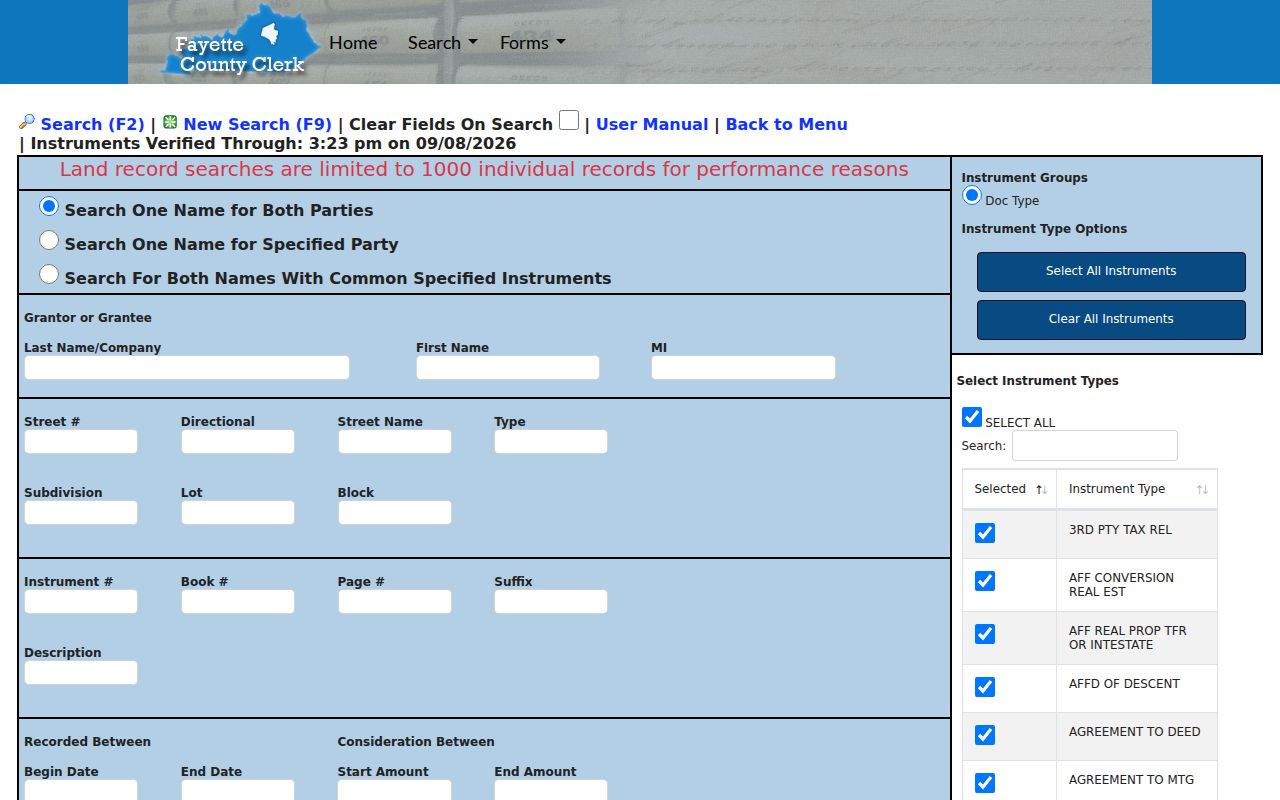
This screen is the official entry point for deed searches. When a filing may be brand new, note the verification timestamp it currently displays.
Read a Fayette Deed Result
One deed result can carry Record Info, recording date, grantor, grantee, instrument type, property description, cross-references, consideration, and image access. Together these fields form a compact trail. Book and page citations plus cross-references often reach the prior instrument faster than a broad name search. The Clerk's deed and plat sample shows each field beside the TIFF and PDF image choices.

That same sample sits a deed next to mortgage, judgment-lien, and release rows. Read the label first. The mix explains why an instrument type must be understood before any ownership conclusion, and consideration is evidence of the recorded transaction rather than a current appraisal.
Build a Fayette Deed Chain
A chain of title is the ordered run of transfers affecting one piece of land. Begin with the newest deed that truly matches the parcel. A name hit alone is not enough. The legal description, book and page, and cross-references hold the chain to the same property. They still work even when a street address changes.
- Find the latest deed by address, legal description, or present grantee.
- Read the grantee, grantor, date, book/page, and property description.
- Search that grantor as a grantee in an earlier date range.
- Confirm the same land, then repeat through each earlier transfer.
- Grantor
- The party transferring an interest.
- Grantee
- The party receiving an interest.
- Chain of title
- The linked sequence of recorded transfers for the same land.
- Book/page
- The reference used to retrieve an instrument or follow a cross-reference.
Mortgages, liens, releases, powers of attorney, and wills can all shape the chain without transferring anything. Match each release or assignment back to its original reference. For a deeper list of prior owners, continue along the Fayette former-owner trail.
Fayette Book, Page, and Plat Clues
Street text shifts over the years. The recorded legal description is what identifies the land. Fayette County deed records can be searched by subdivision, lot, and block. You can also search by description words, instrument number, book, page, and suffix. A condominium may point to a master deed. A subdivision deed may carry a Cabinet/Slide plat reference instead. The Clerk's workflow treats Cabinet as Book and Slide as Page. That bridge ties a deed to its recorded plat. It does so without assuming the neighborhood name is the legal subdivision. A plat can show lots and streets. Yet a current survey remains the right source for a disputed line.
Note: Copy lot, block, unit, and subdivision text exactly before testing a shortened address search.
Fayette Deeds Before Mid-1989
The county reference sets the cutoff. Modern deed images run from mid-1989 forward. Anything earlier moves through Search Prior July 1989, Non-Indexed Documents, and the Digital Access Project. The historic collection spans many book types. Deed, mortgage, will, survey, order, partition, index, and Burnt Records books all appear. It is not one seamless modern index. The DAP book instructions lay out the older volume route.

Pick the right book series, then verify the scanned page. A blank modern search does not mean no historic instrument survives. KDLA holdings and Clerk assistance remain fallback channels for a known volume or reference.
Online boundary. Mid-1989 is the general image cutover, not the beginning of Fayette land history. Older books reach into the 1700s through separate routes.
Fresh Fayette Recording Clues
The portal posts an "Instruments Verified Through" timestamp and offers a Daily Notebook. Treat that clock as a clue. It matters for timing. A document handed across the recording desk can sit outside the main index for a while after filing.
The Daily Notebook lets you surface a recent instrument by date and type. Still, the indexed detail and image remain the confirmation. The PVA runs on its own clock. Its tax roll resets on January 1. The owner field can legitimately lag a new recorded transfer even after the Clerk has processed the deed.
For a same-day question, save the portal's displayed verification time with your search terms. Then check the notebook for date and type. A notebook lead should still be matched to the correct parties and property description once indexing catches up. That sequence keeps you from calling a pending item absent, and it keeps the assessment roll distinct from the recorder's processing queue.
Fayette Burnt Records Explain Gaps
Fayette's first clerk, Levi Todd, kept an early office at Ellerslie Estate. Fire destroyed most records on January 31, 1803. Reconstruction followed in 1818. Surviving proof was copied into eight Burnt Records volumes. Residents also re-recorded their deeds. An early instrument carrying a later copying date may still preserve an older transaction.
The 1897 courthouse disaster is documented, but the exact affected record groups are less certain. Never assign a missing volume to that event without archival confirmation. Wills, orders, surveys, partitions, tax books, and land-entry sources may support a hard early chain.
Keep original dates and re-recording dates in separate columns. Add the book citation and source series too. This keeps a copied instrument from being counted as a second sale. When the deed-book route stalls, Kentucky Department for Libraries and Archives holdings can help identify an available county series or an earlier land-entry source.
Order a Fayette Deed Copy
The Fayette County Clerk accepts document-specific requests online, by mail, and through its land-record office. Supply book and page, type, date, and parties. Add the address, certification choice, and document-control number. The Clerk retrieves an identified record. It will not perform a title search.
A statutory copy costs $0.50 per page. A certified copy costs $5 for the first three pages, then $0.50 per added page, with $1 postage and handling per document. Cash, cashier's or certified checks, business checks, and money orders are accepted. Personal checks are mail-only. Mail requests to Fayette County Clerk, Attn. Land Records, 162 E. Main Street, Room 132, Lexington, KY 40507, and allow up to three business days.
Recorded, not guaranteed. Recording gives public notice, but it does not prove clear title or resolve each lien, error, unrecorded interest, boundary conflict, or claim.
Insist on a Clerk-certified copy when the recipient requires official certification. A Kentucky title professional or attorney is the right source for a title opinion. Check private deed-copy letters against the Clerk's published rates. Pay nothing before that comparison. Routine copies come cheap. They are available from the custodian at stated page charges.
A suspicious notice claiming a lien, foreclosure, or urgent transfer deserves a second look. Look up the instrument number and parties in the official index. Then call the Clerk through its published contact information. Deed fraud or forgery concerns can also be reported to Lexington Police Financial Crimes. Reach them at 859-258-3600 or fraud@lexingtonpolice.ky.gov.