
What Fayette County Property Tax Records Reveal
No single office holds the whole tax file in Fayette County. The PVA sets fair cash value and keeps the parcel facts. The Sheriff mails and collects the current bill. The Clerk handles bill research and records delinquent-tax certificates. Pick the record that fits your question. Then carry one parcel number and tax year across every system.
| Tax-record item | Meaning | Official source |
|---|---|---|
| Fair cash assessment | January 1 value used as the starting tax base | Fayette PVA parcel record |
| Land and improvement detail | Components that may explain the total assessment | Fayette PVA / QPublic |
| Exemption flags | Approved relief that can reduce taxable value | Fayette PVA |
| Bill and payment status | Tax year, amount, discount or penalty stage, and payment | Fayette Sheriff tax lookup |
| Delinquent certificate | A recorded claim for unpaid tax, not proof of ownership | Fayette County Clerk |
Three numbers get confused constantly. The assessment is not the amount due, and neither figure is a sale price. Kentucky assesses real property at 100 percent of fair cash value. Yet exemptions and tax rates shape the taxable result. A deed's consideration sits in the transfer record instead. It may reflect a different date or transaction.
Fayette County Property Tax Uses Fair Cash Value
Kentucky measures real property differently than many states. The Fayette PVA real-property guidance defines fair cash value as the price a willing buyer pays a willing seller when neither side is compelled. The standard is 100 percent of that amount. There is no fractional assessment ratio. The PVA values the parcel but sets no tax rates and collects no bill.
- Assessed value
- The PVA's fair-cash-value conclusion for the assessment date.
- Taxable value
- The amount remaining for tax treatment after applicable exemptions or adjustments.
- Tax levy
- The rate applied by the relevant taxing authority, separate from the PVA's valuation work.
- Tax certificate
- A recorded delinquency claim that remains an encumbrance, not a deed conveying title.
January 1 Controls the Fayette Tax Roll
Fayette County's tax roll follows a fixed calendar. On January 1, the PVA sets both the assessment and the tax-year owner of record. That date controls the bill, not the closing table. So a buyer who closes in the spring may still find the seller listed on that year's tax bill, even after a new deed reaches the Clerk. Mailing addresses are a separate matter. Drawing on deed records, the PVA can route the bill to the new parcel owner. The January 1 rule still stands, though. It fixes who the owner of record is for the whole tax year.
Two clocks: the PVA roll follows January 1, while the Clerk's deed index has its own current verification timestamp.
Names conflict more often than you would think. Compare the assessment year with the deed recording date instead of assuming either source is wrong. That timing check matters most when reading Fayette County property tax records after a recent sale.
Search Fayette County Property Tax Bills
The Fayette Sheriff property-tax lookup is the official route for bill research. Historical years run from 2005 through 2024. Current bills stay with the Sheriff. Delinquent bills pass into the Clerk and County Attorney process.
| Search clue | Use | Check before relying |
|---|---|---|
| Property address | Find a bill when no parcel number is known | Match situs, not merely mailing address |
| Parcel or account number | Carry one exact key from the PVA | Preserve all digits and leading zeroes |
| Tax year | Separate current from historical liability | Do not apply one year's calendar to another |
| Owner name | Cross-check the bill's January 1 owner | A later deed can name a newer grantee |
Always confirm live figures. Open the Fayette tax search directly before drawing conclusions, since amounts and payment status can change.
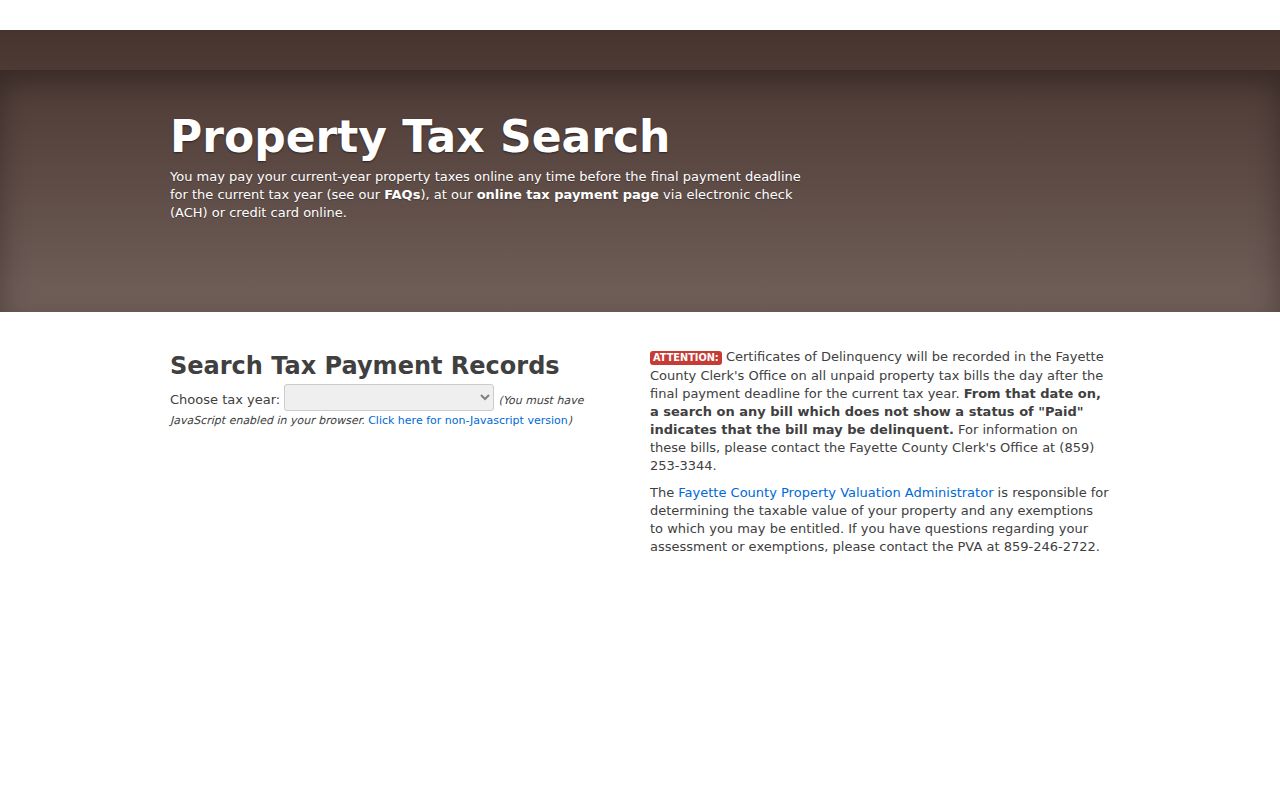
The lookup labels each year and bill source clearly. Match the parcel first. Then match the tax year before treating any figure as the amount owed.
Follow a Fayette County Tax Record Across Offices
A full lookup starts with the parcel and ends with the right bill status. Every step has one narrow purpose. That discipline keeps an assessment screen from passing as a payment receipt, and a tax certificate from passing as a deed.
- Search the Fayette PVA by address and save the exact parcel number, assessment, owner field, and exemption flags.
- Open the Sheriff lookup, choose the needed tax year, and match both parcel and situs before reading payment status.
- Compare assessed and taxable values, noting that an exemption can affect the latter without changing the parcel's market evidence.
- If the bill is delinquent, check the Clerk's tax records and published sale procedure for a certificate or later release.
When a record is not available online, the offline chain still works. The PVA handles assessment data and open-data requests. The Sheriff can pull a current tax bill. The Clerk holds recorded certificates and issues copies of a specific document. Each office fills one link in the chain. An open-records request to any of them may go by hand, mail, fax, or email, and a written response generally follows.
Fayette Exemptions Change Taxable Value
Homestead and disability relief live on the PVA side of the file. Fayette's forms page posts the application routes, including homestead and related property forms. The Kentucky homestead exemption amount is $49,100 for 2025 and 2026. Check eligibility and proof against the current official instructions. An exemption never sets sale value. It never removes the parcel from public property tax records. Read the approval alongside the assessment year. Then compare it to the taxable figure for that same cycle.
About 300 Fayette Areas Shape Reassessment
The 2026 assessment and appeal page describes Fayette's method. The county uses roughly 300 neighborhoods or assessment areas and studies recent sales within each. Reassessment follows a Department of Revenue mandated three-to-four-year, or quadrennial, plan. Those groupings organize evidence only. Two nearby parcels can still differ in features and value. The PVA also physically inspects real property on a four-year cycle. A current sale, permit, neighborhood trend, or corrected parcel fact can shift the picture between rounds. Owners do best comparing like properties. They should also document real differences rather than leaning on a ZIP code or neighborhood label.
Contest a Fayette County Property Tax Assessment
A PVA conference is the first formal step in challenging a Fayette assessment. For the January 1, 2026 assessment, the published conference deadline was May 18, 2026. The Local Board appeal filing deadline followed on May 20. Those dates are cycle-specific, so recheck them every year. Strong evidence includes comparable neighborhood sales, photographs, factual errors, and records showing a material difference between the parcel and the PVA's comparison set.
Appeal window. The 2026 PVA conference closed May 18 and Local Board filing closed May 20; verify the current year's dates before acting.
Deadlines shift with each cycle. Review the live PVA guidance and deadlines before assembling your evidence.
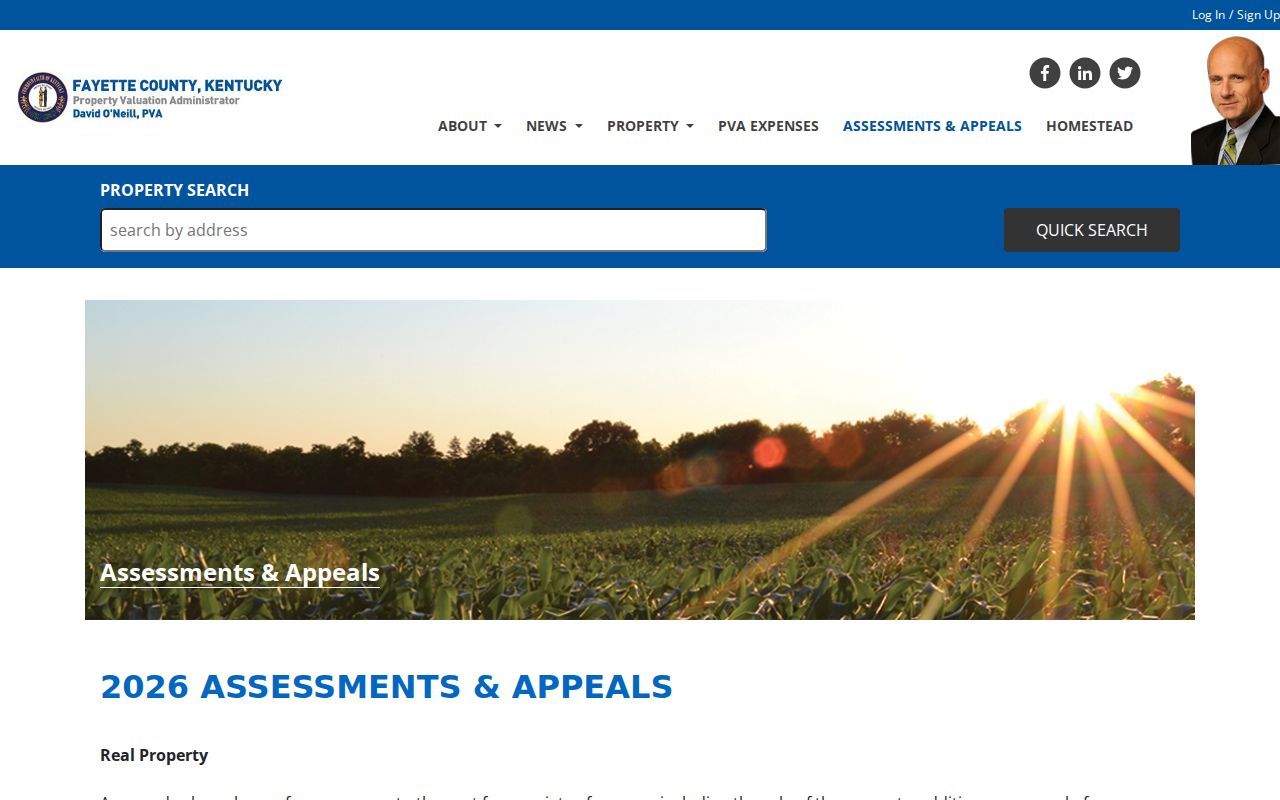
Appeal deadlines follow the assessment cycle for that year. Always confirm the current deadline with the county before filing anything.
A Fayette Tax Certificate Is Not a Deed
A delinquent bill sets a specific procedure in motion. The Clerk and County Attorney handle it under a published calendar. In the 2025 cycle for 2024 bills, the transfer fell on April 15. The list date landed on June 18, and weekly updates ran through July 14. The sale was held July 18. Treat that sequence as an example. Each year gets its own schedule.
Buying at the sale yields a certificate, not ownership. The certificate is recorded as an encumbrance on the parcel. It does not establish that the purchaser owns the real estate. Bankruptcy filings, releases, redemption rights, later court work, and any eventual deed all come into play. Each of those requires separate checking. That distinction keeps Fayette County property tax records from being overstated as title evidence.
Request Fayette Assessment and Tax Records Offline
Not everything can be pulled online. The PVA provides property forms, an information request, and an open-data request. These cover material outside the normal public system. For a current bill, the Sheriff sits at 150 N. Limestone in Lexington. Recorded tax instruments belong to Fayette County Clerk Land Records at 162 E. Main Street, Room 132, Lexington.
The Clerk's published statutory copy charge is $0.50 per page. Its open-records policy allows inspection and copies under Kentucky law. A request should name the parcel, the tax year, the instrument number, or the book and page. Ask for one identifiable record. That works better than asking the office to research an entire ownership or tax history.
Compare Fayette Tax Years Without Mixing Calendars
When comparing tax years, keep the calendars separate. Record the tax year. Record the owner name printed for that cycle. Note the assessment figures. Also note the payment status. The Sheriff's no-JavaScript selector documents historical years from 2005 through 2024. The main lookup carries the current-year emphasis instead.
Discounts, face-value periods, penalties, transfer dates, and sale schedules are all year-specific. The 2025 calendar and delinquent-sale procedure serve as examples only. Before calculating what is due, open the current Sheriff FAQ. Before assuming a certificate is available, check the Clerk's current procedure.
A payment that appears missing deserves a call to the Sheriff. Use its published office information. Keep the receipt or confirmation separate from the assessment card. If a certificate or release is the question, search that exact recorded instrument from the Clerk. Otherwise, request it from the Clerk.