
Trace Fayette Former Owners Backward
Start from a verified present parcel and work backward one transfer at a time. For every step, note the transfer date, the outgoing and incoming parties, the deed type, and the exact book and page. The legal description is what keeps each step tied to the same land.
| Transfer Date | Grantor to Grantee | Deed Type | Book/Page |
|---|---|---|---|
| Newest recorded date | Prior seller to current grantee | As indexed | Newest reference |
| Earlier recorded date | Earlier seller to later grantor | As indexed | Cross-reference or search result |
| Earlier book date | Book grantor to book grantee | As written in image | Historic volume and page |
Never copy names from a sample record into a real chain. Build every row from the parcel at hand. A mortgage, lien, release, plat, or power of attorney can explain a gap in the deed records, but none of them automatically signals a new owner of record.
Reconstruct Fayette's Prior Owner Chain
Open the newest matched transfer in the Fayette Deeds index and read it closely. The parties, date, instrument type, legal description, cross-references, consideration, and image all matter. The grantor in that deed becomes your next search target. Treat that name as an earlier grantee. The current land index exposes the party roles and filters. They make this reverse deed search possible.
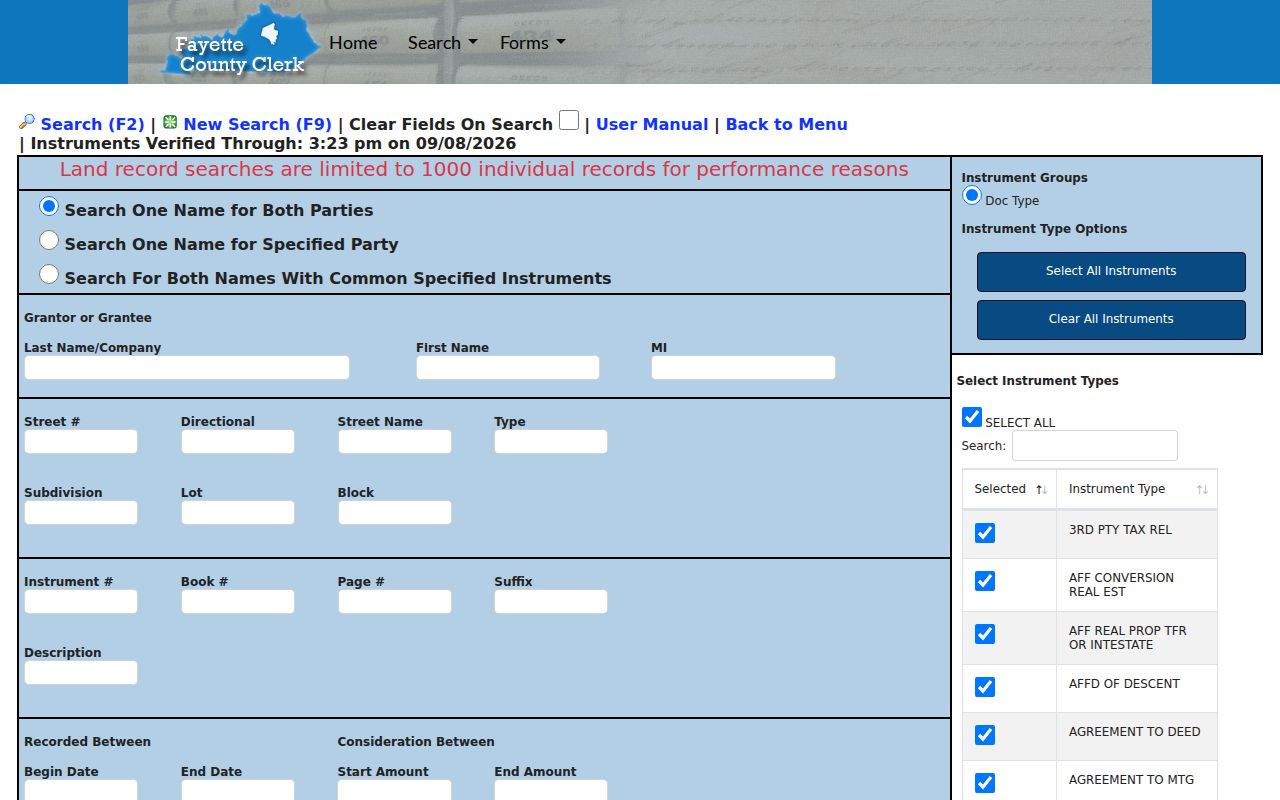
Use the form to step from each seller back to that party's older acquisition of the same parcel. Verify every result against the land description before adding it to the chain.
- Identify the latest deed that matches the parcel's legal description.
- Record its grantor as the most recent former owner.
- Search that grantor as a grantee in an earlier date range.
- Match the same land, add a row, and repeat into older books.
- Grantor
- The party who transferred an interest.
- Grantee
- The party who received an interest.
- Chain of title
- The ordered series of transfers for the same land.
- Reverse index
- An index organized to find the receiving party, useful for locating acquisition deeds.
- Quitclaim versus warranty
- A quitclaim passes the interest held; warranty language adds stated title promises.
Anchor Fayette History to One Deed
The newest result anchors the chain. It has to agree with the property description, not just a shared surname. Fayette's sample result schema lists Record Info, date, grantor, grantee, instrument type, description, cross-references, consideration, and image links. Those cross-references can point straight to an earlier deed. The official deed-result sample shows how the fields fit together.

The sample's lot, block, unit, and subdivision wording shows why a legal description can hold a chain together after a street address changes or disappears.
Keep Fayette Land Descriptions Matched
When names return too many hits, narrow the search. Use subdivision, lot, block, unit, description words, book/page, and Cabinet/Slide. A recorded subdivision plat sets the lot framework. A condo may depend on a unit and master deed. Rural land often uses metes-and-bounds wording. Parcel numbers can split, combine, or change over time. So can street numbers and rural routes. Before accepting an earlier owner of record, compare acreage, adjoining calls, plat references, and cross-references. A directory occupant or neighborhood label is only a clue, never proof of ownership.
Cross Fayette's Mid-1989 Boundary
Modern deed images generally begin in mid-1989. When the chain touches that edge, switch to the pre-July-1989 instructions, Non-Indexed Documents, and the Digital Access Project. Only the access method changes. The ownership history keeps going. The Fayette DAP instructions introduce the volume-based historic route through the deed records.

DAP covers deed, index, mortgage, will, order, survey, partition, and Burnt Records series. Pick the right book type. Then verify the image itself, since an index entry is never the whole transfer.
Time-depth alert. Mid-1989 marks the general online image boundary. Older Fayette owners continue through separate book, archive, and reconstructed-record routes.
Bridge Fayette Estate Transfers
A former-owner chain does not always pass through an ordinary sale. Death can leave a will. It can also leave a probate order, affidavit of descent, executor or administrator deed, commissioner's deed, or a later family conveyance. The probate event may carry one date. The recorded land instrument and the PVA update can carry others, so the chain often shows three. Search the decedent, the estate, the executor, the heirs, and the exact parcel description. CourtNet works as a case lead. Pull the actual court record when its order explains the transfer. A death certificate has its own confidentiality rules and never substitutes for a deed.
Interpret Fayette Burnt Records
A January 31, 1803 fire destroyed most early county records. In 1818, a reconstruction effort copied preserved evidence into eight Burnt Records volumes. Residents also re-recorded deeds. A later record date or duplicate-looking instrument may preserve an earlier transfer. It may not mark a second sale.
Fayette deed holdings reach into the 1700s, though the trail is not perfectly continuous. When an early link is missing, compare surveys, land entries, wills, orders, tax books, and partitions. Do not blame the documented 1897 courthouse disaster for a specific missing volume. Confirm it with an archive first.
Extend Fayette Ownership Through Archives
KDLA's Fayette holdings run deep. Deeds, orders, wills, and marriages appear in long runs, and its land guide ties Fayette research to Virginia surveys, Kentucky entries, warrants, and early surveys. For a targeted pull, use the KDLA research service. In-state research and copying carries a stated $20 fee.
The Kentucky Room at the Lexington Public Library holds historic directories, newspapers, maps, and local indexes. Directories can tie an old occupant to a period. Still, only the deed or tax record itself can prove ownership. Ask for a specific volume, page, or parcel clue. Broad title searches rarely pay off.
Digitized directories span 1864-65, 1877-78, 1906-07, 1923, the early 1940s, plus telephone and farm-directory runs. Note the printed street spelling, number, occupation, and business label exactly as shown. Capture any spouse or widow notation too. Then compare the next available year and map the old address through a plat, GIS address point, or deed description. An occupant listed in a directory may have been a family member, worker, or another non-owner.
Aging court files follow a fixed route. Fayette Circuit records aged 15 to 35 years sit at the State Records Center. Anything 36 years or older goes to KDLA. CourtNet can identify the case. But a probate, partition, or quiet-title order may need a direct archive request before it fills a missing ownership link.
Measure Fayette Ownership Time Depth
How far a chain reaches depends on the parcel and the evidence that survived. The modern index covers recent work. DAP holds the older county books. Archival land-entry or survey material may reach back before the county deed trail. Stop where the evidence stops. Mark a gap instead of inventing continuity.
Keep a research log. Record each former owner, role, transfer date, deed type, reference, description match, and unresolved issue. A split parcel, estate transfer, correction deed, or re-recorded instrument then stays visible instead of collapsing into a simple sale sequence.
Write down failed searches too, since a date range, spelling, or book series that returned nothing can point the next search toward a historic index.
Lawful use. Prior-owner research supports house history and land diligence. It must not be used to track, expose, threaten, or harass a living person.
Use the Fayette deed-copy process for an official copy. A full title opinion belongs with a qualified Kentucky attorney or title professional.